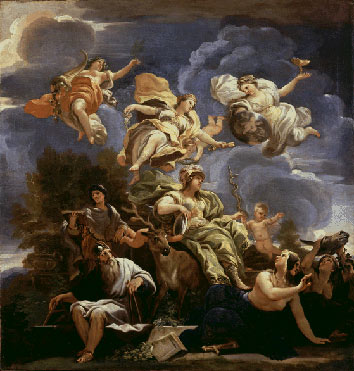
Wednesday, October 26, 2011

Pride vs Humility: From Cain to Aslan to Samson to Mary

Chapter 7. Of fleeing from vain hope and pride.

Thomas offers us a simple warning and a promise:  if we put our faith in anyone or anything other than The Lord, we face futility.  However, God will honor our efforts and intentions if the rationale for these are in accord with His Will.

Cain & Abel
Life is vain for the one who puts trust in the children of Adam or in any created thing (Jer 17:5, Ps 146:2-4).  Do not be ashamed to be the servant of others for the love of Jesus Christ, and to be reckoned poor in this life. (2 Cor 4:5)

Build your refuge in God (Ps 73:28), not upon your own capabilities. Do what is within your power, and God will help your good intent.
Trust in the favour of God, who resists the proud and gives grace to the humble, and do not trust in your learning, nor in the cleverness of others.

Next, Thomas cautions us to build our relationship with God.  He does not say that we should not have wealth or powerful friends, but rather to keep these in perspective: put God first as only He can break the Stone Table.
Aslan & The Stone Table
 It is easy to think our selves as not needing Him when we are in the flower of youth and health.  But this talent is from God Himself.  Think of Samson here.
2. If you have wealth, take no glory in your riches.  If you have powerful friends, do not rely upon that relationship, but in your relationship with God, who gives all things, and in addition to all things, He desires to give even Himself. (1 Cor 1:31).

Sampson & Delilah
 Boasting because of your strength or beauty of body is futile since it takes only a slight sickness for it to fail and wither away. Pride in your skilfulness or ability for fear that it will displease God, from Whom emanates every good gift and talent which we have.

Thomas concludes this chapter with an admonition to stay humble in all of your efforts. With Mary as a model of humility, we can practice our humility and obtain peace and quiet strength.  This does not ever amount to being a punching bag.
3. Do not count yourself better than others, since you will then be accounted worse in the sight of God, who knows what is in a man's heart.


Be humble about your good works, for God's judgments are of another sort than the judgments of man, and what pleases others is ofttimes displeasing to Him (Is 55:6-9).

Mary's Fiat

If you have any good qualities, believe that others have more, and so you may preserve your humility. It is no harm to you if you place yourself below all others; but it is great harm if you place yourself above even one other person. Peace is ever with the humble, but in the heart of the proud there is envy and continual wrath.

Sunday, October 16, 2011

Will This Spaghetti Make Me Restless?

Chapter 6: Of Inordinate Affections (Too much of a good thing).  

Today, Thomas tells us an obvious truth:  that if we eat too much, we will get indigestion; that if we drink too much alcohol, we will suffer a hang-over; that any blessing can be perverted into a curse.  The root of the problem lies in controlling our desires:
1. Whenever you desire more than you should reasonably expect, immediately you become restless. The proud and the self-interested are never at rest; while the poor of spirit and humble of heart abide in peace. Whoever is not wholly dead to self is soon tempted, and is overcome in small and unimportant matters. It is hard for the weak in spirit, especially those who are still in part of the carnal and inclined to the pleasures of the flesh, to withdraw altogether from worldly desires. When withdrawing from these inclinations, he is often sad, and easily angered too if anyone thwarts his will.
From here, good Thomas tells us how to get out of our self-dug hole:  resist these passions by filling your desires with fruits of the Spirit rather than worldliness.

It is OK to enjoy a thing so long as desire for that thing does not turn into an unhealthy desire - be it for more spaghetti, more ale, or more sex, more ______ (there's more to the list...just think of your favorite sins and fill in the blank). 

God does not have laws against charity, joy, peace, patience, kindness, goodness, generousity, faithfulness, modesty, self-control, chastity.  Of these we can have as much as we desire.  Let our passions be for these fruits of the Spirit.
2. On the other hand, if you yield to your tendencies, immediately you are weighed down by the conviction of your conscience; for you have followed your own desires, and yet in no way attained the hoped for peace by yielding to these temptations. For true peace of heart is to be found in resisting your passions, not in yielding to those passions. There is no peace in your heart when you are focused on the flesh. Nor is there peace for you who are given up to the things that are outside of you. Peace rests with you who are fervent towards God and living the life of the Spirit (see Gal 5:16-25).

Thanks for praying along with me,
'til next time, be Imitators of Christ!

Check out my new site!  faithandfidelity.com

Thursday, September 29, 2011

You've Got To Read This Love Letter!

Thomas' good words about reading The Bible will help you think about your approach to reading God's Love Letter.  St. Jerome said that "Ignorance of Scripture is Ignorance of Christ."  Don't be ignorant!


Thomas lays out the primary focus of Scripture - seeking the Truth.  Think back to Chapter 3, where this was explored at length.

Here is Chapter 5: On Reading the Holy Scriptures

1. The Truth is to be sought for in Holy Scripture, not eloquence.

St Jerome in Study

All Holy Scripture ought to be read with that Spirit with which it was written. We must seek insight in the Scriptures rather than for subtle expression. We ought to read the devout and simple books as well as those that are high and profound.
Do not let the authority of the Scripture writer put you off from reading, whether he was of little or of great learning, but let the love of pure truth lead you to read deeply. Do not ask 'who said this?', but rather attend to what is said.

Tattoo of Scripture Scholar

Thomas now cautions us to stay focused. Don't get bogged down in the "pots and pans" of Scripture. "Who wrote what...did I get that verse right?"  Indeed, he counsels us not to be "Scripture Scholars" by knowing chapter and verse as much as to know what God is saying to us and asking from us in His Great Love Letter. Which is not to say that memorizing Scripture is not a wonderful thing, rather it is a caution against obsessing over the letters of the law and missing the Spirit. So the approach is one of humility and openness to learning.  Think of Thomas' method as "God says" rather than St. Paul says in Galatians 6:17 * that ...."
2. Men pass away, 'but the truth of the Lord remains forever.' (PS 117:2 & 1 Peter 1:25). God speaks in many ways to us, regardless of who we are. Our curiosity often hinders us in reading the Scriptures when we attempt to understand and discuss that which should be simply passed over.
If we would receive insight from this, read with humility, simplicity, and faith; and do not seek the fame of being learned in Scripture. Ask after, and hear with silence the words of the saints; and be pleased with the parables of the ancients, for they are not spoken without cause (Sir 3:29).
*Gal 6:17 "From now on, let no one make troubles for me; for I bear the marks of Jesus* on my body."

Some final thoughts on Scripture reading and study: 
First, Whenever someone quotes Bible Verses at you, I recommend reading the whole chapter from which the verse came.  Or at least 10 verses before and 10 after.  Think of all the interesting things we say in emails and how easily a line or two can be taken out of context.


St John Chrysostom
 Second, there are many profound insights on Scripture from the early Church Fathers (e.g. St. Basil, St. John Chrysostom) to St. Jerome to more modern scholars like Dr. Scott Hahn.  You can make a study of The Bible and it will benefit you greatly.  However, as Thomas says, don't get bogged down in some professorial interpretation of a text or book and miss the point.  Studying Scripture is one of my favorite things to do, and it is very easy to get distracted from the message when you are focused on acacia wood versus gopher wood!

God wrote us a love letter!  Read it and enjoy it.  Don't worry too much about what color ink He used, or on what day He wrote His Letter to you and me.  Write Him back, show Him you received His note via your daily actions.

Thanks for reading and praying along with me!

Until next time, be Imitators of Christ!
tim


Saturday, September 17, 2011

Dear Prudence, Won't You Come Out to Play?

Book 1, Chapter 4:   Applying Prudence1 in What We Do.
In returning to Book 1, Chapter 4, Thomas guides us with this useful admonition On Applying

Prudence

Prudence to What We Do, especially in our relationships:

1.  We must be careful in giving credit to every word and suggestion by taking the necesssary time and attention to weighing the matter according to God's Standard.
  Alas!  we are so weak! We often readily believe and speak of another that which is evil rather than that which is good.
  But perfect men do not easily give credit to every report, because they know man's weakness, which is highly prone to evil and always subject to fail in words.

So prudence is applied to our situations involving what comes out of our own mouth and brain. There is a definite pragmatism to prudence: Think of this Cardinal Virtue as "Spiritual Cunning" in that there is a weighing of risk for a positive outcome that benefits not just ourselves, but the common good.

2.  It is great wisdom not to be rash in our actions; nor to be hard-hearted in our own opinion:  Nor should we believe every man's word; nor in-the-moment tell others the things which we have heard or believed.
  Consult with a wise and conscientious man (Tobit 4:18) and seek rather to be instructed by one who is wiser than to follow your own inclinations.
  A good life makes a man wise according to God, and expert in many things.  The more humble a man is in himself, and more subject to God, the more prudent he will be in all things and the more at peace.

Jesus Washes The Feet of His Disciples
The art of prudence, then, is tied closely with humility and reflecting our decisions against what The Lord tells us in Scripture and Tradition. We then balance that base line against the action in front of us, and He enables us to see the result which may seem overly cautious to others, but in reality is a thoughtful decision. Still for others, the decision may seem rash, until again, it is balanced against The Lord's view of things. Think here of Jesus washing the feet of his disciples (John 13). At first, it did not make any sense, especially to Peter. But Jesus clarified everything as he kept to his intent of showing how to lead.

May we be prudent, then, in measuring our thoughts and words toward one another, especially our family members, on this day.

Thanks for praying along with me.
Til Next time, be Imitators of Christ!

fn1 As much as I have issues with "The Beatles," they wrote a song called "Dear Prudence" which had no intent of musing about the Cardinal Virtue of Prudence, but rather was written to cajole a young woman with depression problems, to come out of her hotel room and socialize, I thought a similar cajoling may be necessary to tease Prudence back into our lives. She is in short supply these days, so perhaps this joyful song may bring Her out.

Wednesday, September 14, 2011

A short word on housekeepting: Turning Back to Book 1

I'm heading back to Book 1, and will resume the blog with a discussion of Chapter 4 in the next post.....probably over the weekend.

All the best! 

Keep praying!  Keep Imitating Him!  Wait, that's both at the same time!

Tuesday, August 30, 2011

God Says "I Am Giving You Myself!"

This week I'm taking a moment to reflect on the power of this first chapter of book IV.
Thomas wrenches it all down for us, doesn't he? In this chapter he wonders at our unmerited grace and our unworthiness...and then wonders how God deigns to give us Himself. Shades of St. Augustine.


Cell Penetration: Eucharist & You
 By receiving Holy Communion, God infuses Himself into our very being. By His physical Presence, He uses the material world to penetrate our very cells with His Being...His Flesh, His Blood, so that we may become more like Him. He enters our hearts by becoming ingested particles, our brains soak Him in not just through listening to His Word, but by The Word becoming fles, our flesh, ands dwelling among us.

I recall how joyful Donna would be when we were expecting, since as she received Holy Communion, she knew that The Body and Blood of Christ soared through her veins to the baby inside of her.

As we explore more of book IV, keep this chapter in mind as a proof text for all the pieces that follow...and there are many beautiful chapters to come. One in particular I cannot wait to write about for a friend who is patiently waiting to join the Church and receive Holy Communion. More on that when we get to book IV, Chapter 14. Perhaps I will write about that first. The structure of this book is more of selective meditations than a discourse.

Monday, August 22, 2011

Will Trade Sins for Food

How do we receive strength from The Blessed Sacrament?  By trading our sins for the restoration that is promised from the Food at the Altar(Jn 6:55).  
Christ's Body & Blood

Thomas brings the first chapter of Book IV to a close by bringing us to the reception of the Body, Blood, Soul and Divinity of Christ.

11. Oh, the wonderful and hidden grace of this Sacrament, which only the faithful of Christ know, but unbelievers and such as are slaves to sin cannot experience.

In this Sacrament is conferred spiritual grace; lost virtue is repaired in the soul; and beauty disfigured by sin returns again.
And so great sometimes is this grace that from the abundance of devotion that is bestowed, not only the mind, but the frail body also feels a great increase of strength.
12. Yet it is much to be lamented and pitied that we should be so lukewarm and negligent as not to be drawn with greater affections to the receiving of Christ, in Whom consists all the hope and merit of those that shall be saved.
For He is our sanctification and our redemption; he is our comfort in our pilgrimage, and the eternal beatitude of the saints.
It is therefore much to be lamented that many regarded so lightly this saving mystery which rejoices heaven and preserves the whole world.
Oh, the blindness and hardness of the heart of man that does not more highly prize so unspeakable a gift; and from daily use falls into a disregard of it.


Thomas ends the chapter with a thought that hearkens back to his earlier chastisement about chasing after the bones of saints....why? When the Real Thing is as close as your local Church?
13. For if this most Holy Sacrament were only celebrated in one place, and consecrated by only one priest in the world, how great a desire would men have to go to that place, and to such a priest of God; that they might see the divine mysteries celebrated?


But now there are made many priests, and Christ is offered up in many places, that the grace and love of God to man may appear the greater, the more this Sacred Communion is spread throughout the world.

A prayer of Thanksgiving closes this all-important chapter.  Using Christ's own words of invitation so that we do not make any mistakes as to Who is doing the asking:
Thanks be to You, O Good Jesus, our Eternal Shepherd, Who has graciously agreed to feed us poor exiles with Your precious Body and Blood, and to invited us to receive these mysteries with the very words of Your own Mouth, saying: “Come to Me, all you that labor and are burdened, and I will refresh you.” Matt 11:28.
Thank you for praying along with me.
Until next time, be Imitators of Christ!
tim